HustleandHeart
The Reputation Economy: New Rules for Thought Leaders

The Reputation Economy: New Rules for Thought Leaders

In this age of alternative facts, with megalomaniacs in power, checks for misinformation being removed at the rate of knots, and the tsunami of AI ‘fakes’ adding insult to injury, how do we build our professional reputation?

When the world’s largest social media companies have deprioritised content moderation and are busy rolling back other protections for users’ trust and safety, how do we accurately represent ourselves in a way that is believed?

How do we create a personal brand in 2025, when AI is enabling acres of useful, valuable, relevant marketing to be generated in a matter of moments? How do we stand out, build our professional reputation, and render our competitors irrelevant amid changing consumer behaviours and diminishing digital returns?

Done well, your professional reputation becomes a bankable asset – enabling you to command higher fees, reduce marketing costs as opportunities come to you, attract partnerships that further amplify your visibility, and increase your business resilience during economic downturns.

As we navigate through 2025, the rules of reputation-building are shifting dramatically, creating challenges as well as opportunities for consultants, coaches, experts, and thought leaders.

The new world of influence: Branding, publicity, SEO, social partnerships

When I left the Public Relations industry in 2007, it was at the precipice of the explosion of social media. This wreaked havoc on the PR industry, pitching old school broadcast media, reputation-management PRs who were slow to embrace digital, against the rising new breed of digital and social media natives, who had far less idea about the nuances of credibility and authority.

My proprietary Influence Framework was developed out of this need for an omnichannel, holistic approach to building influence, through a combination of PR and publicity, SEO and content, digital marketing and networking — not as separate disciplines, but as interconnected elements of a cohesive reputation strategy.

Today’s most effective PR strategies focus on creating genuine relationships with platforms and people, which could include podcast appearances, influencer marketing and user-generated content (UGC), speaking engagements, or collaborative content with complementary experts.

Everything is interlinked; when you appear on a podcast, the backlinks from that show’s website boost your search visibility. When you’re quoted in an industry publication, those mentions create digital breadcrumbs that lead new audiences back to your platforms.

Google’s algorithm values expertise, authoritativeness, and trustworthiness (E-A-T) more than ever, which means that your content must demonstrate deep knowledge, while also building strategic associations (read: backlinks and website appearances) with relevant, established, credible platforms.

AI has fundamentally altered how we approach search visibility. With AI search assistants providing direct answers rather than lists of links, your content must now be structured to address specific questions with exceptional clarity and depth.

The omnichannel approach has become non-negotiable. Your reputation exists across multiple platforms simultaneously, and while you absolutely don’t need to be everywhere, having a strategic presence on key platforms creates a powerful network effect, with each touchpoint reinforcing your credibility exponentially.

When someone discovers you, you want them to have a Netflix-binge-worthy experience of you – with a ‘go to’ body of work where they can quickly understand your insights, opinions, and ideas

This integrated approach to PR, SEO, and digital marketing doesn’t happen by accident. It requires insight into how the differing elements work together to build your professional reputation.

Credibility through character

Julia Gillard, Australia’s first female Prime Minister and feminist icon, aided by her viral misogyny speech, was repeatedly reminded that she voted against gay marriage. Her credibility suffered. Admitting that she ‘got it wrong’ went a long way to rebuilding that credibility.

Gillard demonstrated something valuable here – that it’s okay to get it wrong or change your mind – in fact, it’s far preferrable to mistaking integrity for obstinance.

Your professional reputation isn’t just about being known – there are plenty of people who are well known for all the wrong reasons – it’s about being known for something specific and valuable, that’s actually representative of who you are.

You can buy authority, via a talented PR team and behind-the-scenes people. But you cannot buy credibility.

The foundation of any lasting professional reputation is character. In a sophisticated market, audiences have developed a sixth sense for authenticity; we expect transparency and when it’s not given, it’s easy enough to uncover it. In a sophisticated market, we can see when someone is genuinely passionate, or simply chasing trends or engagement metrics.

True credibility emerges from a combination of expertise and genuine character. It’s your everyday small decisions, habits and routines, your emotional regulation when under pressure, your apologies and clarifications. Otherwise known as walking your talk, doing what you say you’re going to do, and how you act when no one is watching.

Your digital footprint – including your comments on other people’s posts, in forums where you believe confidentiality is assured – will be accessible for years to come. Rather than let this to become self-censorship; instead, recognise this invaluable opportunity to get to know yourself, trust yourself, and live in alignment with yourself.

Technology may change, but the fundamental human desire to work with people we trust remains constant. In this new world of influence, establishing credibility through character isn’t just good ethics — it’s good business.

Don’t outsource your creative thinking

Resist the temptation to outsource the very thing that makes you unique – your thinking. By all means, delegate the heavy lifting, but hold onto your original insights and hard-won perspectives.

While your opinions, insights and perspectives may be shared by others, your stories from which these sprung are unique to you alone, and must be told if they’re to be remembered, and repeated.

When the commodity of the age of information is our attention, then the most valuable currency in the attention economy is original thinking.

Anyone can repackage existing ideas – business books are full of them – but those who contribute fresh perspectives, challenge common wisdom, or synthesise established concepts into new approaches, create intellectual value that builds remarkable reputations.

This is the edge of where reputation- and publicity-building and thought leadership blur – because thought leadership is not marketing, and marketing is not thought leadership.

You can be a genuine thought leader with next-to-no marketing nor visibility, and you can have high visibility and a solid reputation, without being a thought leader. Confusing the two is where delusion resides.

This doesn’t mean that your every insight must be revolutionary. Sometimes, your unique value comes from explaining established concepts with exceptional clarity, applying principles across different contexts, or simply articulating what others think, but struggle to express.

Outsource the amplification of your thinking, but ensure your core ideas, densely branded language, and expert frameworks remain uniquely yours.

Our response to controversy is important

Leaders are forged in hard times, not good. The question isn’t whether or not you’ll encounter controversial topics – it’s how you’ll navigate this when it inevitably arises.

In March 2020, I unfollowed and disengaged from a marketer I had respected for years, when she jumped onto an international flight, seemingly to put herself at the centre of the action.
Controversial engagement may create short-term visibility, aided by algorithmic amplification, but it’ll erode your hard-won credibility.

Every field has fault lines, of competing methodologies, ethical dilemmas, or shifting best practices; how you position yourself relative to these tensions communicates volumes. You don’t need to have an opinion on everything, but avoiding controversial topics is the faster way to become the elevator music of the internet.

Approach potential controversy with intention rather than reaction, which means:

  • Choosing which discussions warrant your engagement
  • Responding thoughtfully rather than impulsively
  • Focusing on adding clarity to complexity, rather than taking sides
  • Maintaining respect for those with different perspectives

Your response to controversy signals your intellectual integrity, emotional intelligence, and professional judgment. Leaders who can contribute to divisive topics with nuance, clarity and respect build far stronger reputations far faster, than those who avoid difficult conversations entirely.

Your reputation is a bankable asset

Establishing your professional reputation isn’t merely a nice-to-have — it’s a quantifiable, bankable asset that creates a competitive advantage. When potential clients or partners can easily discover your expertise through multiple channels, when your name consistently appears in conversations about your field, when the ‘word on the street’ about you is generally positive, you’ve built an asset that generates opportunities for years to come.

This asset appreciates over time, creating exponential, compounding returns. Like any valuable asset, your reputation-building efforts need to adapted to changing market conditions, technological shifts, and evolving client needs.

Professionals who recognise their reputation as a strategic asset invest in it consistently, measuring returns not just in immediate revenue, but in long-term growth opportunities.

Need to grow your reputation? Time to say something worth listening to. Time for Ignite Visibility Accelerator.

Client case study: Businesswomen’s networking group elevates program

Client case study: Businesswomen’s networking group elevates program

Women’s business group One Roof is the kind of community that makes you want to stick around, order hot chips and another drink, and open up about all your challenges, curiosities, obsessions, wins, and brain worms, safe in the knowledge that you’ve found your people.

I’ve been a member of One Roof since 2020, when they pivoted their Melbourne co-working space into a virtual membership. One Roof has kept me sane through the exponential rate of change in the online business world, and I’m proud to be a Sydney Ambassador, organising face-to-face events and get-togethers for established business women, growing owners, and those curiously flirting with business.

In 2023, One Roof launched Inner Circle, peer-led coaching circles. As all good online businesses do, they sought feedback from participants with the view to iterating and improving.

In late 2023, they engaged me for a VIP Strategy Session and together, we reimagined the program, redesigned it based on feedback and insights, and repositioned it, to relaunch in early 2024.

The necessity for change

A beta round of Inner Circle in 2023 successfully enrolled 80 One Roof participants at $200 each. Says Frances Goh, Head of Community and Growth, “We believed there was considerable value in the Inner Circle offer, substantiated by excellent feedback from participants.

“But when you’re contemplating a significant price rise, it’s normal to feel uncertain. So we engaged Brook because of her specialist skills in online business, digital marketing and premium positioning.”

The time was ripe. With so many new online businesses, online networking groups, and women’s business groups entering the market from 2020 onwards, One Roof needed to continue to differentiate themselves, especially after a sharp rebrand from Formulaik in 2023 that has elevated their perception.

One Roof were keen to improve, iterate, and reposition the Inner Circle program at a new, higher price that better reflected the value.

Pricing and values feasibility and implications

No business wants to alienate or annoy clients, and any time we seek to change something, we expose ourselves to this. But no matter how collaborative and client-centric our approach is, we also need to balance this with market trends, opportunities, and our personal preferences.

In other words, sometimes we need to be bold and clear with our segmentation strategy.

One Roof owner Sheree Rubinstein and Frances have a naturally collaborative, generous-spirited approach which is absolutely crucial if you’re to run and grow a networking group.

They have firm fans and excellent client retention, but change is the only constant in business (and life!). The larger One Roof has become, the more invaluable resources have been created. Ironically, for the membership business model, the more resources provided, the trickier client retention becomes as it is easier for people to become lost or overwhelmed, and to opt out.

This common issue for membership owners means that it’s not your fault, but it becomes your problem.

The Inner Circle program was a way to add additional value to members and profit to the business by focusing on the diamond of One Roof’s value proposition – its networks.

Increasing the price six-fold

Together, we created a new membership tier, which included Inner Circle in the new tier. The price was lifted from $200 to $1999, including an annual membership. Changes were introduced, including elevating the central feature of relationship-building.

While most owners know the value of their network, in practice, this is far harder to actually do — requiring time, chance (or luck!), emotional intelligence, patience, and many more attributes. One of the key features of Inner Circle, which makes it so valuable, is the curation of each small group.

Sheree and Frances spend considerable time picking individual members of each group, carefully curating the personalities, business types, and maturity levels of each. Inner Circle was restructured to rotate the groups, so that Inner Circle members would commit to a longer period of time, and rotate to different groups, which means more opportunities to meet other businesswomen and get to know, like and trust them.

Changing the program format also meant opening up a rolling enrolment, thereby expanding promotional periods and opportunities for sales — both to existing members and to attract new members to the One Roof world.

What I delivered

Alongside two in-depth strategy sessions with Sheree and Frances, our VIP Strategy Session included the new tier membership run sheet with a new profit plan for One Roof.

I delivered an in depth website analysis and suggested changes, plus a new sales page for the membership, alongside other detailed recommendations, listed in order of priority, focusing on improving membership retention and client experience.

The new Inner Circle program launched at the beginning of 2024, to a higher than anticipated response!

“People are loving the new format and getting a lot out of it, with an 85% ‘excellent’ response to our client satisfaction survey,” says Frances. “Working with Brook gave us the confidence to put it out there and her perspective brought so many little nuggets of gold that we hadn’t considered.”

(Please note, my link to One Roof is an affiliate link, which means I receive a small financial reward for any sales that eventuate. I would never recommend something that I didn’t enjoy, use myself, and genuinely recommend.)

11 lessons from 11 years of teaching groups

11 lessons from 11 years of teaching groups

In 2012, when my babies were aged two and three, I started running group courses around Australia, mainly to flee the chaos of working from home with my partner, who is also self-employed.

Friends would see our lives and gushingly say, “you’re living the dream!” But I was knee-deep in nappies, nap times, client phone calls, and other people’s marketing. It looked a lot different from the inside.

My very first course I held in a café in Newtown, on a stinking hot Sydney summer day. Seventeen owners turned up, and I had a blast. A couple of months later, I booked a flight to Melbourne and the rest, as they say, is history.

For about eight years, I ran courses across Australia, in venues large and small including hotels, gorgeous AirBNBs, restaurants, art galleries, and other creative spaces. I wish I’d kept records of all the different groups I’ve led over the years – I’m guessing it would number in the hundreds.

In 2015, I started running my flagship program, Hustle & Heart, and I’ve run countless short and long online courses, classes, keynotes, programs, webinars, conference presentations, and lunch-and-learns since, under my own brand, as well as on behalf of other businesses and training institutions.

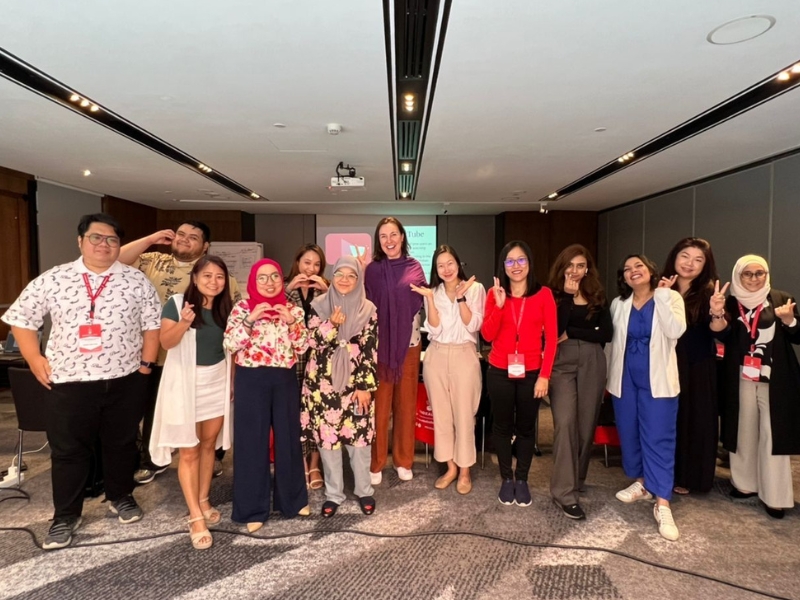
In 2023, I taught internationally for the first time, running five different courses across two trips to Malaysia, on digital marketing and brand storytelling.

Here are the eleven key lessons that I’ve learnt, especially if you’re keen to start, or improve your skills in teaching groups.

1: Your authority has to be claimed

You and you alone must claim your authority to teach or train. And having experience of doing something in just your own business isn’t enough (“I’m proof!” is not proof. Rather, this is ‘evidence by anecdote’).

You need to have broad experience applying your expertise in a wide range of situations, over some years.

I’d been working in online communications for eight years when I began teaching. Before starting my business in 2008 as a digital marketing agency, I’d managed a large website on behalf of a multinational organisation, regularly interviewing, writing, and promoting articles (this was ancient history, before social media, before proper web analytics, when the technology looked very different).

I don’t believe you need qualifications to teach. I’ve met qualified trainers who are terrible and unqualified trainers who are awesome. You get to decide that you’re ready. Don’t let anyone (including me) stop you.

2: The first time will be the worst time

Nobody wants to hear this. The first time you deliver a new course, workshop or program will be the worst time – and the best time, if you stop stressing and criticising yourself and start living in the moment.

Time and again, I witness owners attempting to anticipate the unknowable and plan the unplannable, causing far more stress and work than is necessary.

I take plenty of notes while delivering my first course, including what’s good and what’s not, when chronology has gone a bit awry, and great questions from participants that I can work into draft two. The second time will be 73 per cent better. But you must do the first time to get to the second time.

3: Set expectations and welcome people in

If you love gathering groups together and haven’t yet read The Art of Gathering by Priya Parker, go get it now.

Recently, I attended a small event in Sydney in a private home. I got some automated emails, but none had the address. I was lucky to have the organiser’s mobile number (which wasn’t ideal and wasn’t in any email) and texted her to get the address.

When I arrived, the door was ajar so I let myself in. Nobody greeted me, nor said hi when I walked into a room with a long table full of people talking. (File this under ‘what not to do’).

Etiquette isn’t difficult – it’s mostly about being thoughtful, considerate, and anticipating other people’s needs.

4: Group dynamics are everything

Whether you’re face-to-face or online, group dynamics have a massive influence over the success or failure of a course or program.

I’ve taught the same course or program, at the same venue, with disastrous groups and excellent groups. The dynamics of groups cannot be underestimated.

Take your time in the beginning to settle in, set expectations or seek feedback on group agreements, share names and a little background info, and introduce yourself beyond your LinkedIn bio.

As the trainer or facilitator, you can influence the level of openness in the room by sharing personal or quirky or funny information about yourself, permitting others to do similarly.

5: Give people a quick win

I once called a course participant, asking for her feedback, who told me, “you took too long to give me the first actionable tip. I don’t care about the history of social media.” Fair call.

Too often, we cling to chronology without thinking about our audience – who are there because they want a transformation.

Unless you’re teaching history, forget about giving too much background information.

Structure all your training and facilitation to give a quick win upfront – something highly valuable that causes people to sit up, take notice, and immediately apply what they’ve learnt for significant gains.

This has multiple benefits: it earns people’s trust and attention, it will be remembered far more if it’s at the beginning or the end, than lost in the middle, and it gives you satisfaction, and hence, motivation to do a stellar job.

6: Teaching is far more than knowledge and information

In the age of Google and YouTube, you better believe that teaching is about far more than just information. We buy group programs and online courses because we want a guide to curate only the most essential information and help us to apply it to our unique situations.

I like to factor in a 50/50 ratio of learning and applying, which means if I teach a concept for 20 minutes, then we have 20 minutes to apply this in an exercise, reflect, discuss, and seek feedback. All of my courses and programs have an assignment of sorts that participants complete throughout – whether this is a marketing plan, profit plan, sales page, or email funnel.

Nobody wants to leave a course with a notebook of good intentions that quickly gathers dust, leaving you feeling guilty and resentful.

7: Tap into the wisdom of the group

While teaching/training and facilitation are often discussed together, there is a massive difference between these.

Training is the old-school model from school where the teacher talks from the front of the room. Facilitation is when the facilitator provides resources, questions, exercises, and opportunities to provoke the group to discuss, share, apply and learn together, harnessing the collective wisdom of the group.

A skilled person can move seamlessly between training and facilitation, as the situation requires.

8: Make it relevant to make it powerful

Knowledge is theoretical. When we apply it, we make it practical. Examples from the real world go a long way to illustrate your teachings and how they can be applied.

But the best skill you can cultivate as a teacher, trainer or facilitator, is thinking quickly and speaking confidently, to apply what you’ve just taught to a participant’s unique circumstances.

After 11 years and hundreds of groups, this is one of my superpowers. When we make it relevant to people, we make it powerfully valuable.

9: Feedback is invaluable – treat it as such

Two years of receiving weekly feedback, when I worked as a tour leader in south-east Asia, has given me a thicker skin with feedback. Even feedback that is seemingly irrelevant can hold a kernel of value for you – perhaps if only to show how your marketing needs to change, to better repel the wrong people.

Don’t be so precious that you put yourself above feedback. And if someone is willing to give it, be curious, courteous, and grateful, even when you don’t like what you hear.

10: Don’t be boring

Boring should be a crime. Life is short and other people’s precious time and attention is the most precious thing we have. Don’t squander it by being dull.

I learnt how to be more entertaining by analysing others on stage – noticing why some people appeared dull, and others were entertaining.

Much of this has to do with energetic presence. You can be more entertaining, fascinating and interesting to others by being more interested in others, more present, and thus, more spontaneous. When we’re not caught up in our heads, we’re naturally more charismatic. Plus, your jokes get funnier the more you practise them.

11: Make it simple, not simplistic

“If you can’t explain it simply, you don’t understand it well enough” said Albert Einstein.

Many people misunderstand this and believe the opposite to be true: that something must appear complex and difficult if it’s to be valued. Ha! It takes a lot of skill to make something complex appear easy and simple.

However, simple is not simplistic. We undermine other’s intelligence, while also eroding our credibility and authority when we overlook subtleties, nuances, and exceptions to the rule, in favour of black-and-white statements.

My aim in teaching and training is to always make the complex appear simple and easy. When we can equip our participants with knowledge and empower them to apply it immediately, then gains become exponential, as the gap between knowing and doing disappears.

Would you like to elevate your expertise into a premium flagship group program? This is exactly what we do inside of the Leverage Mastermind.

The only thing you can control

The only thing you can control

Smart business owners are excellent at creating immense stress through thinking. Lots of smart owners come to me skirting the edges of burnout, made worse by the fact that they can’t point to an external event that’s causing them stress.

On paper, everything appears dandy. Internally, they’re suffering under immense strain to

  • Increase their revenue and profits
  • Save the world
  • Save the whales
  • Get fit and healthy
  • Prioritise wellbeing
  • Be kind and generous, without giving everything away leaving you a hollow wreck
  • Be intellectually challenged
  • Enrol in that course/qualification/PhD you’ve been eyeing
  • Get a good night’s sleep.

Smart business owners are too hard on themselves to label themselves Type As (“Surely I’m not good enough to be a Type A?!”) but clearly, their self-imposed expectations make the sky seem not high enough.

Get clear goddamnit!

To make matters worse, in the midst of a burn-out-existential-crisis, said Business Owner typically decides that they just need to Get Clear On What They Want, and everything’s coming up roses.

So ‘Get Clear!’ gets heaved atop the castle of expectations, another casualty in the pursuit of peace.

Business plans are rubbish

Typically, a crisis calls for a plan. Said Business Owner is convinced by some well-meaning friend that it’s the lack of business plan that’s the problem.
Except most business plans are rubbish: a relic from another era for an entirely different purpose – to raise capital and showcase the business to the board.

For agile owners, a traditional business plan makes no sense whatsoever, and could even be damaging, should the owner be sufficiently distracted by trying to cleave off parts of their round peg to fit the square hole.

A plan is useful when it’s used, amended, added to, reviewed – when it has the look of your favourite dog-earned, oil-splattered recipe.

A traditional business plan is none of these things. In a world of exponential change, a traditional business plan is a death knell.

Habits, rituals, routines

The only thing you can control is yourself. That includes what you do with your hours and minutes, but also your thoughts, feelings, beliefs, opinions and attitudes.

Your thoughts, beliefs and feelings are just as habitual as your habit of coffee first thing in the morning, or Netflix after dinner.

Feeling overwhelmed is a habit. As is feeling confused, worrying, seeking copious feedback on all decisions, or taking too much responsibility for things outside your control.

In the last 20 years, neuroscience has shown us that our brains are highly malleable and equipped to deal with the volatile, unpredictable vagaries of the twenty-first century. To use this, we must treat our thinking as habits to be either strengthened or redesigned.

You can change the way you think, the lens through which you view the world, and even the way you treat time – not as an enemy to be conquered, but as a friend.

Managing expectations

You might think that I’m now going to tell you to opt-out of the hustle and grind, find a forest, and spend your days listening to the sweet gurgle of the stream, fossicking for joy in each precious moment.

Alas, this is a fantasy for some, and neither practical nor appealing to others.

While I’m a huge fan of doing less admin, housework, volunteering, and all manner of other modern detritus that sucks my lifeforce, I don’t believe that opting out of modern society will reduce stress or overwhelm, for most of us anyway.

Instead, I propose:

  • Getting on the ‘no train’
  • Embracing ‘selfish’ as a compliment
  • Prioritising thinking time
  • Flexing your brain towards the many and varied possibilities of how you can exchange value for money
  • Setting aligned goals that you actually care about
  • Making action plans rather than business plans
  • Prioritising regular time for activities that regulate your nervous system

Prioritising joy

Being successful is not the same as being happy. And while I’m pretty damn happy on holidays or while walking in the bush near my house, when the sun comes in sideways and has an extra quality that makes it distinctly winter, this isn’t enough to build a life around.

What I’m aiming for – and I guess you are too? – is to create success on my own terms, working for love and money.

And – here’s the clincher – to do it without creating stress, overthinking, or being so wedded to the outcomes of actions that nothing less than expectations being 100 per cent met will do.

The only thing you can control is how you fill your minutes and hours. The outcomes are not within your control.

What most people really need help with isn’t being successful in business: it’s being happy while being successful. After all, a successful business owner who’s unhappy doesn’t look like much of a success.

It’s taming the monkey mind to think less and focus instead on useful rituals, habits and routines. It’s sleeping soundly at night despite the ongoing, never-ending to-do list. It’s being okay with not knowing (the outcome, the future…). It’s being so fiercely committed to the things you care about that honoring these commitments is building self-love, self-trust, and deep self-satisfaction.

It’s divorcing work from suffering, work from dirge, work from obligation, and untangling productivity from self-worth. It’s prioritising joy in each minute, despite (despite, despite). It’s creating a new, twenty-first marriage between success and happiness.

Want to learn how? Join Audacious.

Leadership in the age of alternative facts

Leadership in the age of alternative facts

At the ripe old age of 22, after having a grand misadventure overseas and spending a year sequestered with my parents, licking my wounds, I became a leader. A tour leader, to be clear.

It was my job to lead groups of tourists across borders, picking them up in Bangkok or Ho Chi Minh city, and traveling across Cambodia, and back again.

It was a weird kind of healing, in retrospect. Jumping back on the horse, so to speak, to prove to myself that a ruinous experience didn’t have to define me. That I could, instead, create a new story for myself.

I have been wary of talking and writing about leadership in this age of alternative facts.

There are already far too many articles declaring the many luminous attributes that make up a leader. Too many articles purporting to detail what we need in order to craft workplaces of the future.

It’s enough to make you want to take a big long nap (followed by a champagne breakfast).

There’s a word that I use – and prefer – far more than leadership. Because it’s not prescriptive, it encourages individuality and creates the conditions needed for success to flourish.

That word is character. Defined as “the mental and moral qualities distinctive to an individual”, this enables you to lean back into more of what makes you, you, while also emphasising the development of your personal moral code.

A leader for the bad times

A leader who’s a leader in the good times only, isn’t a leader. Anybody can lead a party and enjoy themselves while doing so.

Arguably, leaders show up in the bad times, when things are difficult, complex, ambiguous or uncertain.

Leadership is the actions you take when nobody is watching and when you stand to gain nothing but knowing you did the right thing.

There are many jostling to be leaders in the good times, but far fewer who show up through the bad times.

Harnessing your energy

Rather than talk about the attributes that make a good leader – covered by thousands of business articles elsewhere – I want to talk about harnessing your energy.

Especially if you don’t have a lot of support and resources to draw on, knowing how to harness your energy is critical.

Starting with the basics – sleep, good food and regular exercise – there are many energetic practices that will help you maintain, increase or harness your energy to draw upon when you need it.

Our body creates a cocktail of energy in multiple ways, particularly when under stress or pressure. While research shows that chronic stress is unhealthy over the long term, bursts of stress can produce some spectacular physiological reactions that enable us to rise to meet a challenge. In other words, our bodies are conspiring to help us out.

Growing your capacity

You know how some people appear to be superhuman? They appear to single-handedly manage massive responsibilities, juggle competing roles and demands, and look cool, calm and capable while dancing through life?

Their leadership secret is capacity.

They know how to regulate their emotions and moods, they prioritise rest and rejuvenation (though this might not be clearly seen), and they grow their ability to deal with more, seemingly without ill effects.

Growing your capacity enables you to grow and scale your business. And to do so without increasing your stress, overwhelm and, eventually, burning out.

Growing your capacity means building your immunity to the harmful effects of stress while raising your ability to enjoy your progress.

Growing your capacity means having unwavering self-belief that you’re on the right path. (Despite setbacks, despite disappointments, despite ….) Thus avoiding the emptiness that many people experience once they’ve achieved a milestone because they’re been striving for an arbitrary goal with which they have little, or no, emotional connection.

The pause between your reaction and response

To further develop your leadership skills, a great starting point is to embrace the pause between your reaction and your response as this is the only thing that’s truly within our control.

Says Viktor Frankl, “Between stimulus and response, there is a space. In that space lies our freedom and our power to choose our response. In those choices lies our growth and our happiness.”

Frankl’s 1946 book Man’s Search for Meaning, about his experiences as a prisoner in Nazi concentration camps during World War II, is an eye-opening examination of the power of choosing your response.

The pause is not about denying or suppressing how you feel, but rather, making a wise decision on the best course of emotional, mental and physical response.

The pause invites you to consider the future you want to be part of and create it in the present. The pause between one breath and your next is where the character of leadership grows.

Are you ready for grow your leadership? Then check out Audacious Mastermind.

Case study: for-purpose PR Louise Nealon

Case study: for-purpose PR Louise Nealon

Louise Nealon is an award-winning Public Relations Director who specialises in supporting purpose-led organisations and campaigns. Louise started her own business, in partnership, in 2007. After 10 years, she relaunched under her own name.

When Louise began one-to-one business coaching with me in July 2021, she was already earning excellent money, with a stable of retainer clients who considered Louise as part of their team, complemented by recurring annual project work, including a boat in the Sydney to Hobart race and Queer Screen’s Mardi Gras Film Festival.

Having co-owned a PR consultancy in Sydney city and managing a team in her first business, she didn’t really want to lease a city office and hire a team, but was unclear about how she’d earn more otherwise. Louise had rebranded under her own name, with beautiful professional photography, and her business looked awesome from the outside.

But she was keen on more.

Earnings plateau

Louise had been stuck in an earnings plateau for some time, she hadn’t put her prices up for years, and was keen to redefine her relationship with money as well as her business.

Says Louise, “I was going through the motions. I’d lost my mojo. I was keen to explore various options for redesigning my business model and what they could look like.

“I chose you because I’d been a long-time email subscriber of yours and loved what you said and the way you said it. I loved your purpose. ‘Hustle and heart’ says it all about you.”

Embracing the hustle

The first problem that Louise identified was a great reluctance to negotiate rates and talk about money. She found pricing proposals took a lot of time and energy and understood she needed to change her attitude and beliefs around money and pricing.

We set a conservative monthly revenue goal which she smashed quickly, so the second goal she set was 75% higher again. She’s exceeded this several times since. Part of this progress included speaking with long-term clients about her value and how that could be remunerated better.

Through business coaching, Louise increased her prices, started invoicing upfront, changed her terms and conditions, chased outstanding bills that were causing significant stress, and created proposals to streamline her quotation process, while improving her conversion rate.

“Brook helped me examine my revenue regularly and explore various options to leverage my expertise, cultivate more of the work that I loved, and delegate, outsource, or partner with others who could take on pieces of work that I wasn’t passionate about.”

“I can easily become overwhelmed but Brook has have a way of breaking down complex things and apply a laser focus to see beyond what I can see. She bring this infectious fun energy which changed my opinion on sales, business development and marketing. She made it fun to work on my business.”

People-centric business

Together, Louise and I looked at her innate strengths and talents, things she was deeply curious about exploring, and areas that she was competent in, but had lost interest in.

“You made it about me the business owner, not just the business. I especially enjoyed the insights I gained about designing my ideal lifestyle and how my schedule could look.”

We explored different business models and options for how to manage client work as well as work more collaboratively, to develop her professional skills as well as reduce the isolation that being in business for yourself so often means. Louise became more strategic and focused with her networking, developing a team of service professionals to complement her skill set and offer a wider array of services to clients and prospective clients.

“There was nothing we didn’t explore, from exercise and nutrition, to where I was living – I’ve since moved out of the city and bought a house by the beach with my wife! – to goals that went far beyond the business.” Louise hired an organiser to help her move into her new house, and joined the local bootcamp on the beach.

“I totally appreciate now just how important your attitude, health and wellbeing and outlook is to your business’s bottom line.”


From service provider to business owner

One of the big changes in identity Louise made was from service provider, at the beck and call of clients, to expert and owner. Instead of being paid to do the ‘grunt work’ of raising visibility and publicity on behalf of her clients, Louise is changing her approach, to being paid for her strategic ideas, for others to implement.

“You’ve definitely increased my self-belief and changed my perspective of myself, from service provider to business owner.” Louise now treats her business like one of her clients, scheduling time for regular business planning, brainstorming and creativity.

Louise has improved her decision-making abilities as an owner – which is a central skill – including not agonising about turning down less-than-ideal clients. “You have a great ability to help me find solutions very quickly that always seemd to work.”

Louise can discern between fast decisions and those requiring more consideration, and regularly carves out time making decisions, rather than rushing the process because it feels uncomfortable.

But perhaps the biggest change is the sea change, from an inner-city Sydney suburb, to a beach-side house south of Sydney.

Says Louise, “My self-trust and self-confidence have hugely increased through working with you. Work has gone from something quite stressful to really enjoyable. I see a future for my business now, whereas before my retirement plan was to win Lotto! You make business fun – like I can achieve anything.”